Why Your Agency Needs a Single Source of Truth for Campaign Data
DA Lytics Team
The Hidden Cost of Scattered Marketing Data
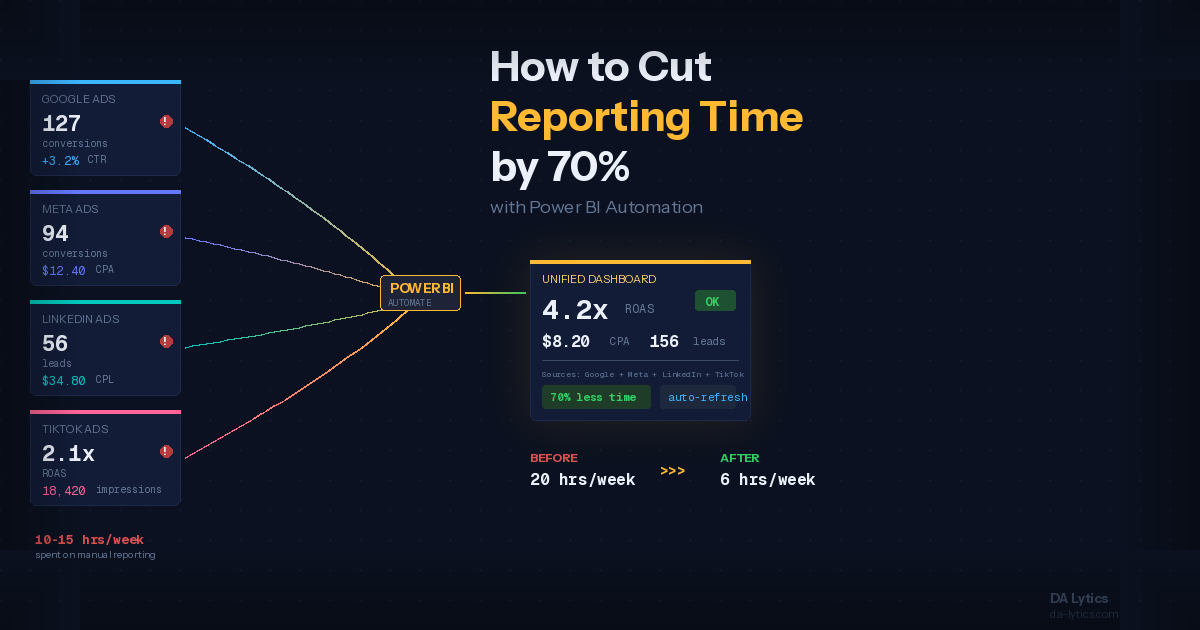
Your agency runs campaigns across Google Ads, Meta, LinkedIn, TikTok, and a handful of other platforms. Each one has its own dashboard, its own metrics definitions, and its own way of counting conversions. When a client asks "what is actually working?", your team spends hours pulling numbers from different tabs, copying into spreadsheets, and reconciling data that never quite matches up.
According to Funnel's 2026 State of Marketing Intelligence report, nearly 80% of marketers say they lack clarity on what is truly working across channels. That is not a data problem. It is a structure problem. And it is costing your agency time, credibility, and revenue.
A single source of truth for your marketing data fixes this. Here is why it matters and how Power BI makes it practical for agencies of any size.
What Is a Single Source of Truth for Marketing Data?
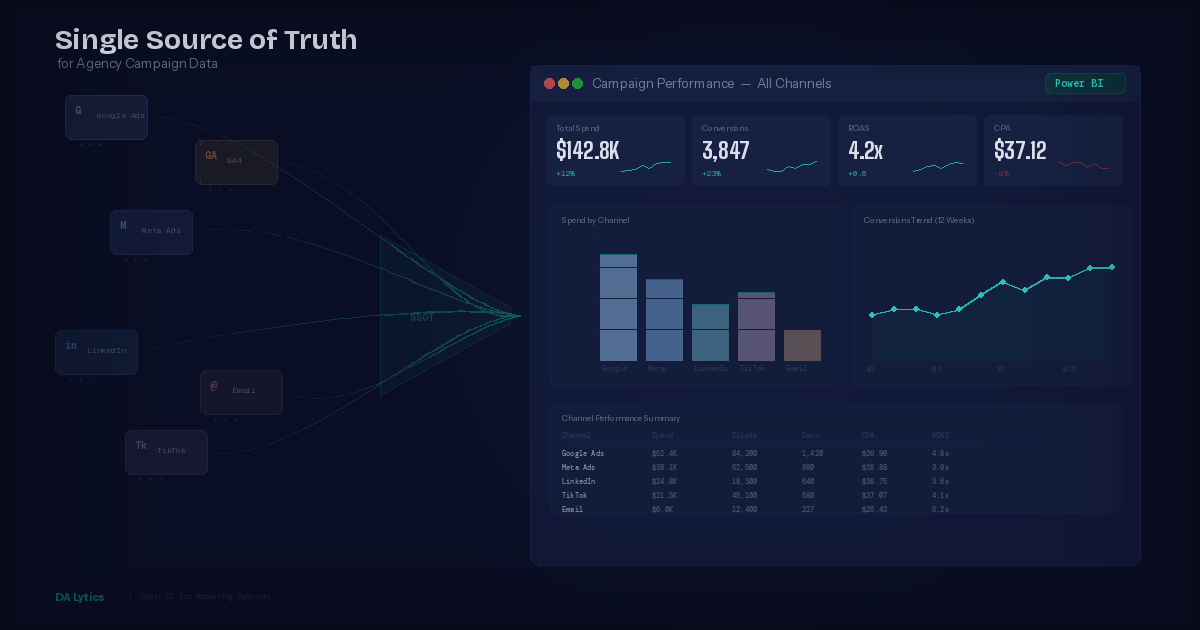
A single source of truth (SSOT) is one centralized place where all your marketing data lives, cleaned, standardized, and ready to analyze. Instead of logging into five platforms and comparing numbers that use different attribution windows and metric definitions, you open one dashboard that shows the full picture.
For marketing agencies, this means campaign data from every ad platform, analytics tool, and CRM flows into a single data model. Metrics like cost per acquisition, return on ad spend, and conversion rates are calculated once, using consistent logic, and everyone on the team sees the same numbers.
This is different from just having a lot of dashboards. Many agencies have dashboards for each client and each platform but still lack a unified view. The difference is in how data is structured underneath. A true SSOT connects the dots between platforms so you can compare Google Ads performance against Meta performance using the same definitions and the same time windows.
Why 80% of Marketers Are Flying Blind Without One
The statistics are striking. Funnel's 2026 research found that marketers self-rate their performance at a B-minus, and only 8% of in-house marketers and 21% of agency marketers consistently use advanced analytics to inform campaigns. The majority rely on basic, platform-by-platform reporting that tells them what happened but not why or what to do next.
Here is what this looks like in practice at a typical marketing agency:
- Monday morning: A team member spends two hours downloading CSV exports from Google Ads, Meta Business Suite, and LinkedIn Campaign Manager.
- Monday afternoon: Another hour goes into cleaning the data, mapping campaign names that are slightly different across platforms, and building a summary spreadsheet.
- Tuesday: The client asks why conversions dropped last week. The team scrambles to cross-reference data from three platforms, each showing different numbers because of different attribution models.
- Wednesday: A second client questions why their report shows different ROAS than what they see in Google Ads. The answer involves a 15-minute explanation of attribution windows and data lag.
This cycle repeats every week. It drains hours that could go toward strategy, optimization, and winning new business. And the worst part? Even after all that work, 41% of marketers admit they report results without actually analyzing the "why" behind the numbers.
How Power BI Creates Your Agency's Single Source of Truth
Power BI is built for exactly this kind of challenge. It connects to hundreds of data sources, lets you build a unified data model with consistent calculations, and delivers interactive dashboards that update automatically. Here is how agencies use it to create a real SSOT.
Connect All Your Data Sources in One Place
Power BI connects natively to Google Analytics, Google Ads, Facebook Ads, LinkedIn Ads, Salesforce, HubSpot, and many more platforms through its extensive connector library. For marketing agencies managing multiple clients across many platforms, tools like Funnel.io simplify this further by collecting data from over 500 marketing platforms, cleaning it, and feeding it directly into Power BI.
Once connected, the data refreshes on a schedule you set. No more manual CSV downloads on Monday morning. Your dashboards show the latest numbers automatically, every day.
Standardize Metrics Across Platforms
This is where the real value of an SSOT emerges. Using DAX (Data Analysis Expressions) in Power BI, you define your metrics once and apply them consistently. Cost per acquisition means the same thing whether the data comes from Google Ads or TikTok. Return on ad spend is calculated using the same formula across every channel.
This eliminates the "your numbers don't match" conversations with clients. When everyone looks at the same centralized report, the discussion shifts from reconciling data to interpreting insights and making decisions.
Automate Client Reporting
With Power BI, scheduled data refreshes keep dashboards current without manual intervention. You can share interactive reports with clients through Power BI Service, giving them real-time access to their campaign performance. For agencies that prefer PDF delivery, Power BI integrates with Power Automate to generate and email reports on a schedule.
Agencies that implement this kind of automation cut their reporting time significantly, freeing up hours every week for strategic work that actually grows the business.
What Does This Look Like in Practice?
Imagine a mid-sized marketing agency managing 15 clients, each running campaigns across three to five platforms. Before building an SSOT, the agency's reporting workflow looked like this: two full-time team members spent roughly 60% of their week on data collection and report building. Client questions about performance required hours of investigation because data lived in different places.
After implementing Power BI as their single source of truth with Funnel.io feeding the data pipeline, the same agency saw dramatic improvements. Reporting that previously took 8 hours per client per month now takes under 2 hours, most of which is spent on analysis and recommendations rather than data wrangling. Client satisfaction improved because reports were consistent, timely, and easy to understand.
The team reallocated their freed-up time to campaign optimization and new business development. Within six months, the agency had taken on five additional clients without adding headcount, because their data infrastructure could scale.
Five Signs Your Agency Needs a Single Source of Truth
Not sure if this applies to your agency? Here are five warning signs that your current data setup is holding you back:
- Your team spends more time building reports than analyzing them. If data collection and formatting take up the bulk of your reporting hours, you have a structure problem, not a people problem.
- Clients question your numbers. When the data in your report does not match what clients see in their own platform dashboards, trust erodes quickly. A unified data model with transparent calculations solves this.
- You cannot answer "what is working" across channels. If comparing Google Ads to Meta requires opening two tabs and doing mental math, you are missing the cross-channel view that drives real optimization.
- Onboarding new clients takes weeks of setup. Without a repeatable data infrastructure, every new client means building reports from scratch. An SSOT lets you template your approach and scale faster.
- Your best people are stuck on manual tasks. Talented analysts and strategists should be finding insights and recommending optimizations, not downloading CSVs and fixing broken spreadsheets.
How to Get Started
Building a single source of truth does not have to be a massive, months-long project. Here is a practical path forward:
Start with your highest-value clients. Pick two or three clients where reporting is most painful and build their unified dashboards first. This gives you quick wins and a template to replicate.
Choose your data pipeline. Decide how data will flow from marketing platforms to Power BI. Tools like Funnel.io handle the extraction and cleaning, while Power Query in Power BI handles any final transformations you need.
Define your core metrics. Agree on how you calculate CPA, ROAS, conversion rate, and other key metrics. Write these as DAX measures in Power BI so they are consistent across every client and every report.
Automate the refresh. Set up scheduled data refreshes so dashboards are always current. This is the step that eliminates manual Monday morning data pulls for good.
Consider working with a specialist. Implementing Power BI for agency reporting is a specific skill set. At DA Lytics, we specialize in building Power BI reporting solutions for marketing agencies. We understand the unique challenges of multi-client, multi-platform environments and can help you build an SSOT that scales with your business.
The Bottom Line
Marketing agencies in 2026 face a clear choice: keep wrestling with fragmented data across dozens of platforms, or build a single source of truth that turns raw numbers into actionable insights. The agencies that choose the latter are the ones winning new business, retaining clients longer, and scaling without proportionally scaling their headcount.
Power BI makes this achievable. With the right data pipeline, a well-structured data model, and automated reporting, your agency can move from reactive number-crunching to proactive strategy, exactly where your expertise belongs.
Ready to build your agency's single source of truth? Get in touch with DA Lytics and let us help you transform your reporting workflow.